

Gujarat’s infrastructure map just got a major upgrade. On 31 March 2026, Prime Minister Narendra Modi formally inaugurated the 109 km Ahmedabad–Dholera Expressway, an access-controlled highway built at a cost of more than ₹5,100 crore. For anyone tracking the rise of the Dholera Special Investment Region (SIR) — and especially the much-talked-about Dholera semiconductor plant — this expressway is more than just another road. It’s the backbone that ties Gujarat’s commercial capital to what is fast becoming India’s most important industrial and technology corridor.
What the Ahmedabad-Dholera Expressway Brings to the Table
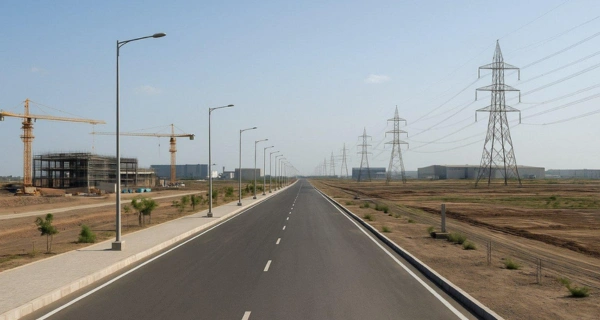
The expressway runs from Sarkhej in Ahmedabad to Adhelai near Bhavnagar, passing through key nodes including Bavla. It is a four-lane corridor, expandable to eight lanes, and was built by the National Highways Authority of India (NHAI) under the Bharatmala Pariyojana, fully funded by the Government of India. The project was executed in four packages by different contractors, with construction spanning several years and a few rounds of delay before the final opening this year.
The single biggest headline from the inauguration is travel time. Where the Ahmedabad-Dholera drive once took well over two hours on older roads, the new expressway is expected to bring that down to roughly 45 minutes. For daily commuters, logistics companies, and the thousands of engineers and workers who will eventually staff Dholera’s industrial units, that is a transformative change — turning what used to be a half-day round trip into a quick, predictable commute.
Alongside the expressway, PM Modi also laid the foundation stone for several other Gujarat road projects, including the four-lane Idar-Badoli bypass and an upgrade to a stretch of National Highway 754K near Dholavira, signaling that this expressway inauguration is part of a much larger regional connectivity push, not a standalone event.
Why This Matters So Much for the Dholera Semiconductor Plant
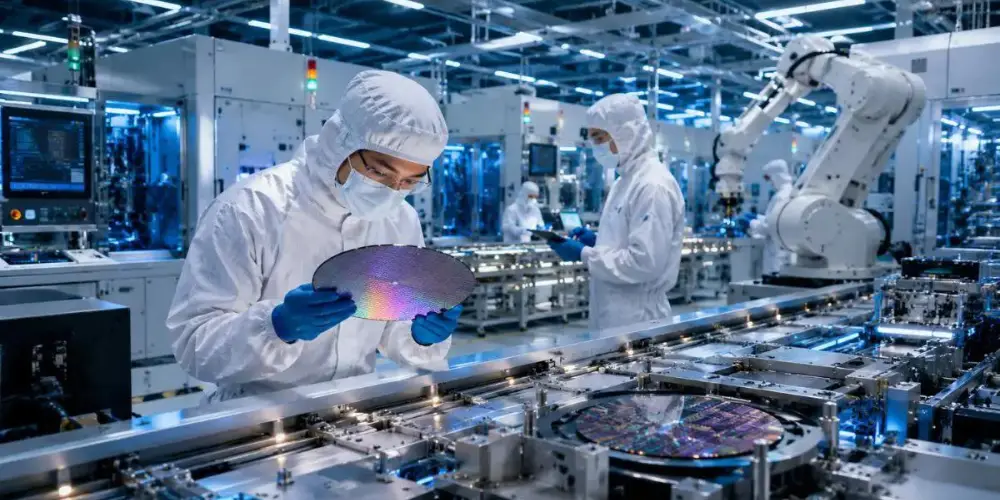
Dholera SIR is home to India’s most closely watched semiconductor project: the Tata Electronics–PSMC (Powerchip Semiconductor Manufacturing Corporation) fabrication facility, a ₹91,000 crore investment with a planned capacity of up to 50,000 wafer starts per month. Construction on the fab has been progressing steadily, reportedly crossing the halfway mark earlier this year, with a Special Economic Zone notified for the project and equipment installation now underway.
A semiconductor fab of this scale doesn’t run on chips and cleanrooms alone — it depends on seamless logistics for equipment, raw materials, and a large skilled workforce that needs to move in and out of the region every single day. That’s exactly where the Ahmedabad-Dholera Expressway becomes critical infrastructure rather than just a convenience. Faster, reliable access from Ahmedabad — the state’s largest talent and business hub — makes it far more practical for engineers, technicians, and support staff to work at the Dholera semiconductor plant without needing to relocate immediately, while also easing the movement of high-value, sensitive equipment central to fab construction and operations.
The expressway also strengthens Dholera’s broader multi-modal ecosystem, improving access to the upcoming Dholera International Airport and planned port connectivity, both of which are essential for a semiconductor supply chain that depends on speed and precision.
The Bigger Picture: Dholera as an Industrial Magnet
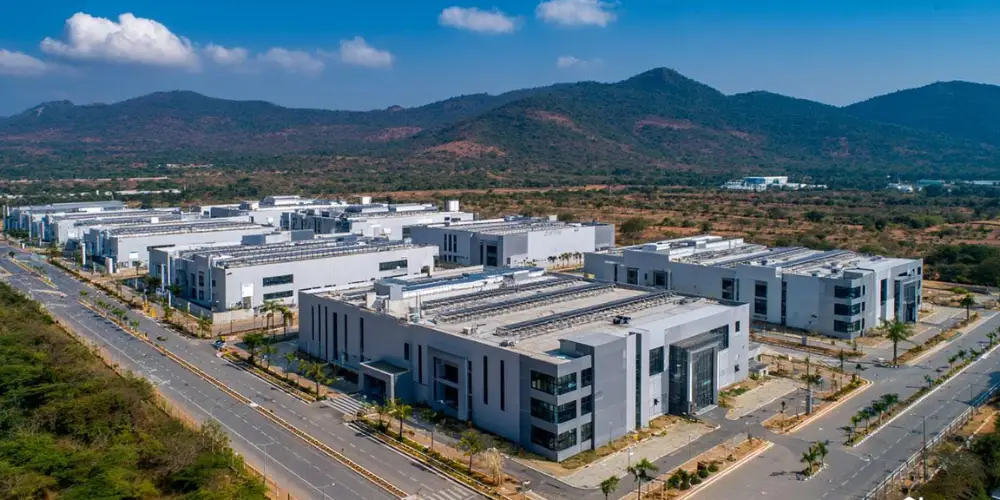
Beyond semiconductors, Dholera SIR is drawing interest from other technology and manufacturing players, with reports of additional MoUs and partnerships in the data centre and electronics space. Better road connectivity tends to have a compounding effect: it lowers the cost of doing business, shortens supply chains, and makes the region more attractive for ancillary industries, warehousing, and residential development to support the growing workforce.
For real estate observers and industrial investors, expressway inaugurations like this one are typically inflection points — land values and interest in the corridor often see a noticeable uptick once physical connectivity actually materializes rather than remaining on paper.
Final Thoughts
The inauguration of the Ahmedabad-Dholera Expressway on 31 March 2026 is a landmark moment for Gujarat’s infrastructure story. Cutting travel time to around 45 minutes doesn’t just help commuters — it directly supports the ambitions of the Dholera semiconductor plant and the wider Dholera SIR, both of which depend on fast, dependable connectivity to Ahmedabad’s talent pool and business ecosystem. As construction on the Tata-PSMC fab continues toward its target production timeline, this expressway will likely be remembered as one of the enabling pieces of infrastructure that made India’s semiconductor ambitions logistically possible.
FAQs
It was inaugurated by PM Narendra Modi on 31 March 2026.
It is a 109 km, four-lane access-controlled expressway, expandable to eight lanes.
Travel time is expected to drop to approximately 45 minutes, down from over two hours earlier.
It improves logistics for equipment and materials and makes daily commuting easier for the workforce at the Tata Electronics–PSMC fab, supporting faster, more efficient operations.
Tata Electronics, in partnership with Taiwan’s Powerchip Semiconductor Manufacturing Corporation (PSMC), is developing the ₹91,000 crore fab in Dholera SIR.