
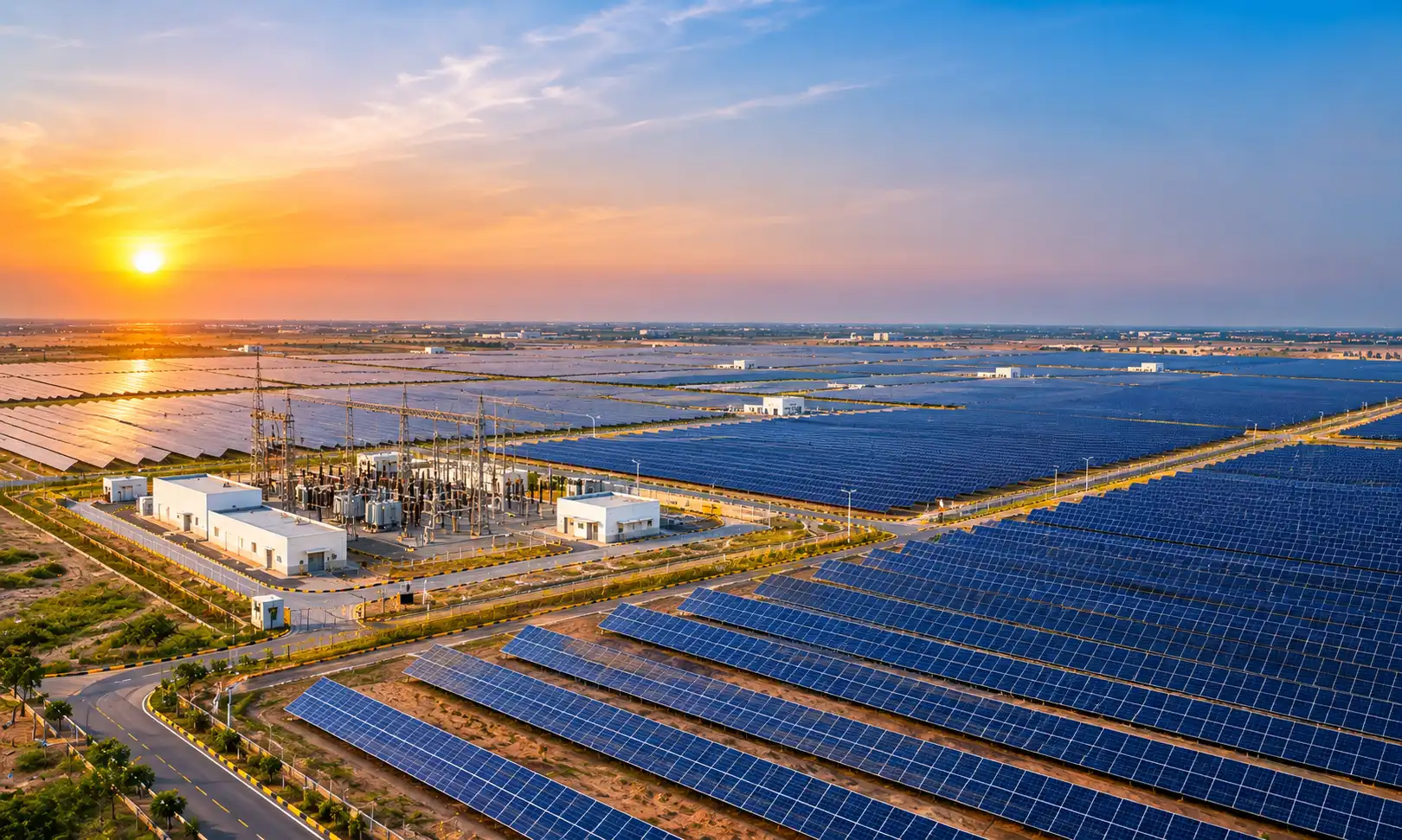
Most new cities plan their roads first and worry about electricity later. Dholera took a different route. Alongside its roads and industrial zones, Gujarat set aside a vast stretch of land near the sea for one purpose: capturing sunlight at a massive scale.
That plan is the Dholera Solar Park, a 5 GW project inside the Dholera Special Investment Region (DSIR). When it was announced, it was billed as India’s largest solar park. Its story has included big ambitions, failed tenders, tough terrain and real progress on the ground.
Here is a clear look at what the project is, how it has moved forward and why it matters for Dholera.
Dholera Solar Park at a Glance
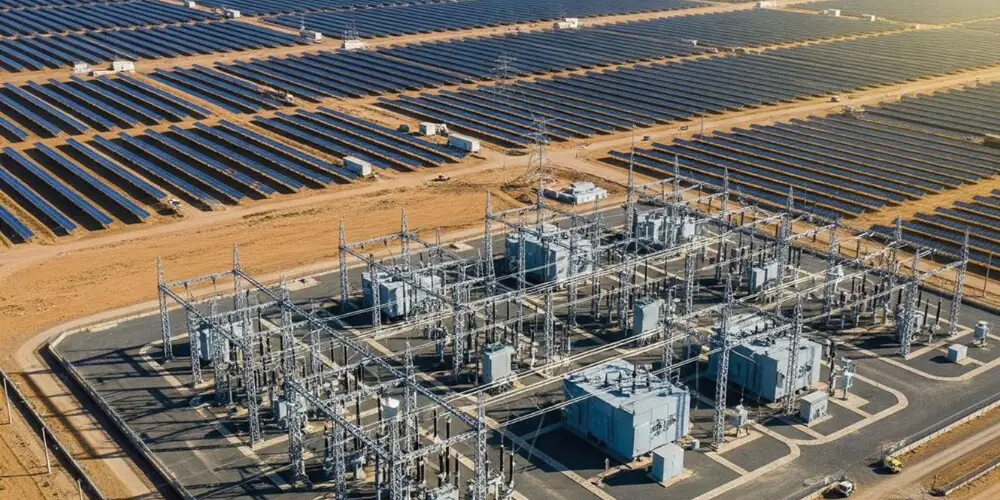
If you only need the key facts, start here.
| Detail | Information |
| Location | Dholera Special Investment Region, Gujarat |
| Distance from Ahmedabad | Approximately 80 km |
| Planned capacity | 5,000 MW (5 GW) |
| Land area | Around 11,000 hectares (about 27,000 acres) |
| Estimated investment | Around ₹25,000 crore |
| Setting | Coastal land along the Gulf of Khambhat |
| Tender agency | Gujarat Urja Vikas Nigam Limited (GUVNL) |
| Capacity target | 5 GW by 2030 |
| Major commissioned plant | Tata Power’s 300 MW project (2022) |
Some project profiles quote a smaller area of 8,595 hectares, so the exact footprint varies by source. The 11,000-hectare figure is the one reported most often.
Why Dholera Was Chosen for a Mega Solar Project
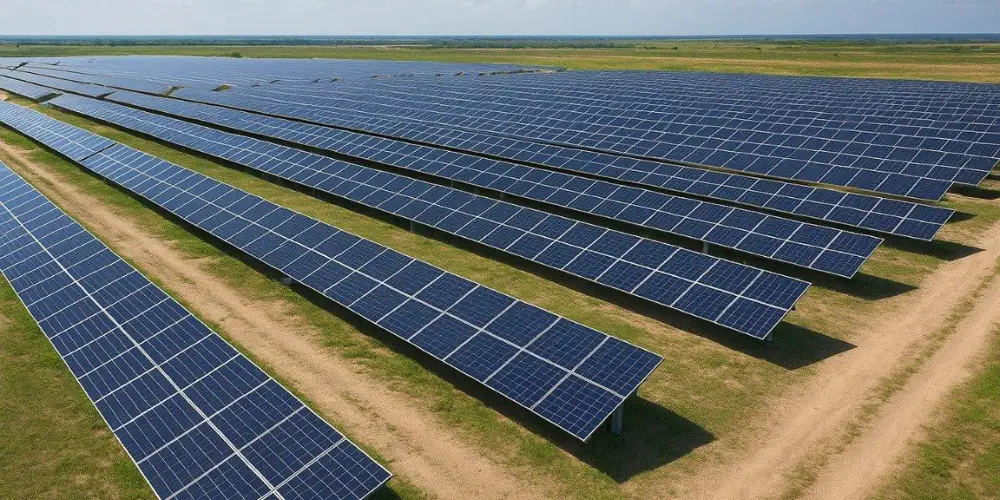
Solar parks need huge, open land parcels. Dholera offered exactly that. The park sits on government-owned wasteland along the Gulf of Khambhat, so it does not compete with dense urban development.
The location needed a special clearance, though. The land falls under the Coastal Regulation Zone, and Gujarat received specific permission to build there.
There was also a larger plan behind the choice. Dholera is India’s greenfield smart city project, announced in 2009. A large clean power source inside the region strengthens the city’s long-term infrastructure story.
Gujarat also had experience on its side. The state had already built India’s first solar park at Charanka, which gave it a working model for this much bigger attempt.
From Approval to Action: The Project Timeline
The project moved fast on paper. On-ground delivery took longer. These are the main milestones.
- April 2018: The Gujarat Chief Minister approved the solar park.
- May 2018: The Ministry of New and Renewable Energy gave its approval.
- January 2019: GUVNL issued a tender for the first 1 GW phase.
- February 2019: Conditional approval arrived for the first phase of development.
- May 2019: An auction aimed at 1 GW awarded only 250 MW, all to Tata Power Renewable Energy.
- November 2019: Tata Power secured another 50 MW.
- August 2020: A 700 MW auction drew strong interest and tariffs of ₹2.78 to ₹2.81 per unit.
- October 2020: Tata Power won a further 100 MW, taking its Dholera allocation to 400 MW.
- March 2021: GUVNL issued a fresh 700 MW tender with 14 plots of 50 MW each.
- April 2022: Tata Power commissioned its 300 MW project.
The tender history explains a lot. Progress came in steps rather than one large leap, and pricing was a repeated point of debate.
Inside the Park: Layout, Technology and Power Evacuation
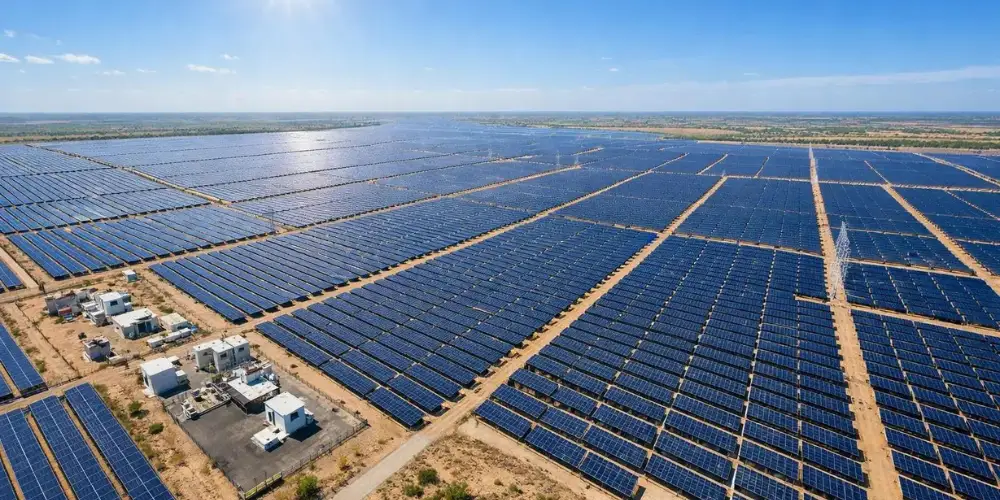
A 5 GW park cannot function as one giant plant. It works more like a planned industrial estate, with developers building on allotted plots.
Plot-based design: One published profile describes a layout of 11 blocks with 27 plots in each block. The 2021 tender offered plots sized for 50 MW, and developers had to bid in multiples of that figure.
Shared infrastructure: The plan was to provide power, water and evacuation substations at the park boundary. This lowers the burden on each developer and supports quicker execution.
Solar technology: Early plans specified polycrystalline silicon modules with efficiency above 15%. Technology has since moved forward, and the park’s flagship plant shows how.
Moving the power: The design includes a 49 km underground cable network at 33 kV to carry electricity within the park.
Tata Power’s 300 MW Plant: The Proof of Concept
Tata Power’s project is the park’s best-known success. Commissioned in 2022, it was announced as India’s largest single-axis solar tracker system.
Trackers let panels follow the sun across the sky instead of staying fixed. This design helps a plant capture more sunlight through the day. Tata Power expects the project to generate 774 million units of electricity every year.
Other developers have also been linked to the park. SJVN announced a 100 MW plant with an outlay of ₹450 crore, while Vena Energy (100 MW) and O2 Power (200 MW) have been tracked as pre-construction projects.
The Challenges That Slowed Progress
A project of this size was never going to be simple. Dholera’s biggest difficulties came from nature and pricing.
Monsoon flooding: Large parts of the site can stay under water for several months during the monsoon. Developers must plan for serious civil work before installing panels.
Tough terrain: The coastal site sits between the high-tide and low-tide lines of the Gulf of Khambhat. That raises construction demands compared with dry, stable land.
Tariff pressure: Developers said the price ceilings did not match the site’s difficulty. An early 1 GW tender failed to attract bidders for this reason.
Falling solar prices: When GUVNL found a tariff of ₹1.99 per unit outside solar parks, it sought to cancel costlier auctions, including the 700 MW Dholera round. That led to the 2021 re-tender.
None of this cancels the project’s value. It simply shows why a 5 GW target is a long-term build, and not a single construction cycle.
What the Solar Park Means for Dholera SIR
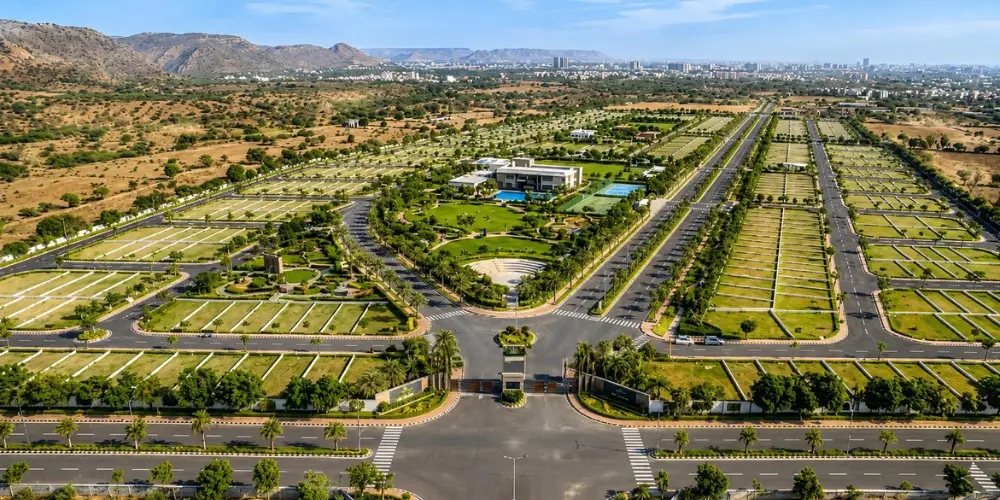
The park’s importance goes beyond megawatts. It connects directly to how Dholera is being positioned for the future.
Cleaner power for industry: Manufacturers increasingly value access to renewable energy. A large solar source within the region supports that demand.
A stronger utility pitch: Dholera has promoted its power tariffs, its solar park and its digital networks as reasons for industries to choose the region. Reliable utilities help businesses focus on operations.
Support for state energy goals: Power from the park helps Gujarat’s state distribution companies meet their Renewable Purchase Obligations, which require them to buy a set share of clean energy.
Economic activity: Construction, operations and maintenance can bring contractors and technical work into the area, adding to the region’s wider development.
A broader energy vision: Plans for Dholera have also included a 200 MW wind park with a ₹1,400 crore investment, pointing to a mix beyond solar alone.
Dholera Solar Park and the Bigger Green Energy Picture
India’s solar push depends on large parks that bundle land, approvals and grid links in one place. This approach lets developers avoid assembling these pieces on their own.
Dholera also fits into a national story. It was first planned during India’s drive towards 175 GW of renewable energy, and it was one of the country’s largest proposed solar sites. Larger concepts, such as the 25 GW plan for Ladakh, have appeared since then.
The lesson from Dholera is practical: scale alone does not make a project succeed. Land quality, tariffs, climate and grid access all matter. The 300 MW Tata plant shows the site can deliver when those pieces come together.
For anyone tracking Dholera, the solar park is worth watching as one signal among many. Keep an eye on new commissioning announcements, fresh tenders and transmission upgrades, as these will show how quickly the 5 GW vision takes shape.
FAQs on Dholera Solar Park
It is in the Dholera Special Investment Region, Gujarat, along the Gulf of Khambhat and roughly 80 km from Ahmedabad.
The planned capacity is 5,000 MW, or 5 GW, with a target of 2030.
It is commonly reported at around 11,000 hectares, or about 27,000 acres.
The project was estimated at around ₹25,000 crore.
Tata Power Renewable Energy commissioned a 300 MW project in 2022.