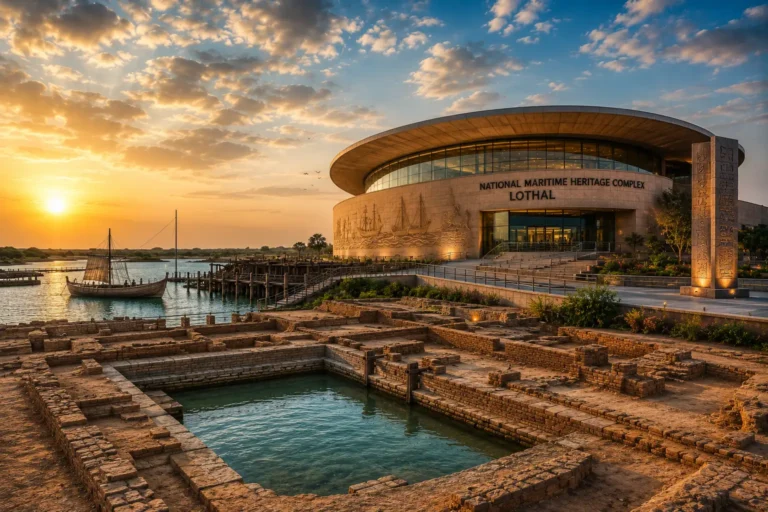
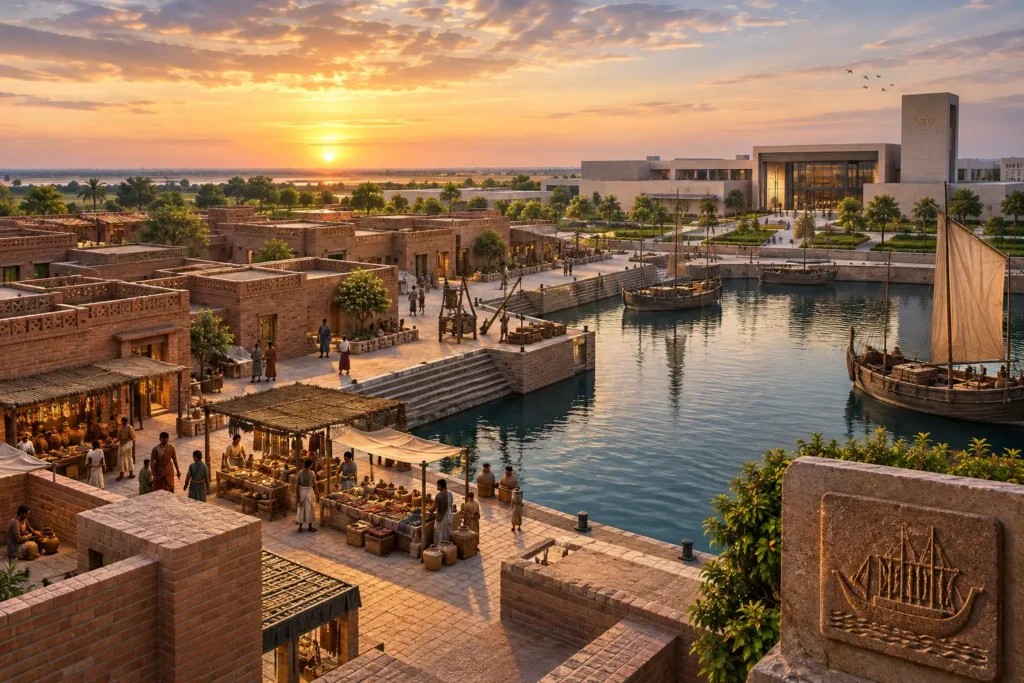
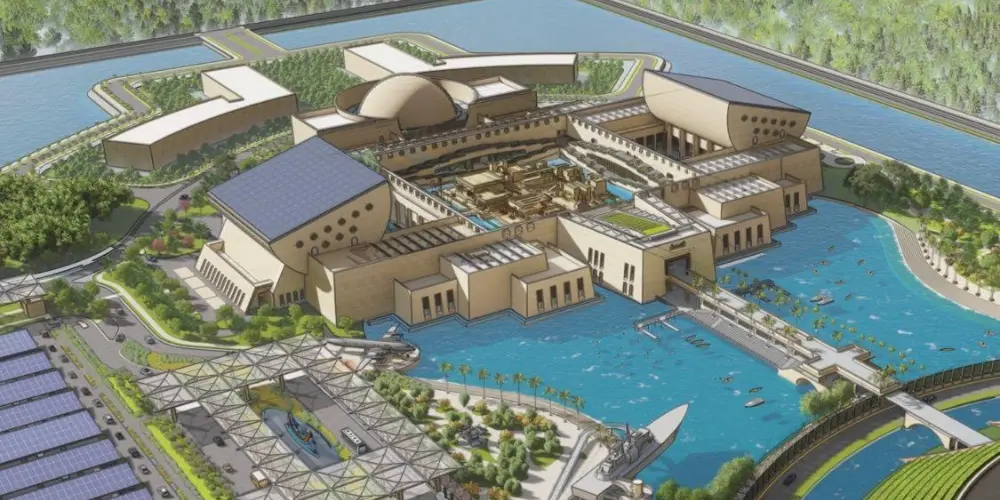
Most museums ask you to look at the past through glass. Lothal Town at the National Maritime Heritage Complex (NMHC) asks you to walk through it instead. Built inside the central courtyard of the museum and framed by a water body that echoes the ancient Lothal dock, this mini Harappan town is designed as a full sensory voyage — not an exhibit you observe, but a place you spend an afternoon and an evening inside.
Here’s what makes it one of the most anticipated attractions in Gujarat’s heritage circuit.
What Exactly Is Lothal Town?
Lothal Town is a re-imagining of a small Harappan settlement, created within the museum complex to carry visitors into a historical setting rather than merely describe one. The idea is simple and ambitious at once: rebuild the everyday texture of a 4,500-year-old port town and let people live inside it for a few hours.
- Located in the central courtyard of the National Maritime Museum at NMHC
- Surrounded by a water body that recreates the ambience of the old Lothal Dock
- Designed as a walkable town, not a static display
- Built to host both daytime exploration and evening programming
The result is a space where architecture does the storytelling.
Ancient Streets, Houses and Markets Brought Back
The town recreates key maritime and urban features drawn from three Harappan sites, replicating the architecture and town planning that made the civilisation famous. Harappan cities were remarkable for grid-planned streets, standardised brickwork and drainage systems that predate most of the ancient world — and Lothal Town puts that planning back on its feet.
- Replicated ancient houses, streets and market spaces
- Architectural and urban-planning details modelled on real Harappan settlements
- A layout that lets visitors understand scale and proportion by walking it
- Visual continuity with the actual Lothal excavation site nearby
You don’t read about Harappan town planning here. You navigate it.
The Barter Marketplace: Trade Without Money
The standout feature of Lothal Town is its marketplace, conceived as a working recreation of barter exchange. Long before coins and currency, Harappan societies traded goods directly — grain, beads, shell, copper, cotton — across an economy that stretched to Mesopotamia and the Persian Gulf.
- A market where things are exchanged the old way, without a medium of exchange
- Recreates a society that functioned entirely without money
- Turns economic history into a hands-on activity rather than a wall panel
- Especially engaging for school groups and family visitors
It’s an unusually clever piece of museum design: the lesson is embedded in the transaction itself.
Walkthroughs, Workshops and Food Stalls
Lothal Town is built to be an engaging, active space rather than a scenic backdrop. The programming is layered so that different kinds of visitors — a curious solo traveller, a family with restless children, a heritage tour group — all find a way in.
- Guided and self-paced walkthroughs of the reconstructed town
- Workshops connected to Harappan crafts, trade and daily life
- Food stalls woven into the streetscape
- Marketplaces that double as demonstration spaces
Together these turn a heritage visit into something closer to a day out.
Evening Shows by the Water
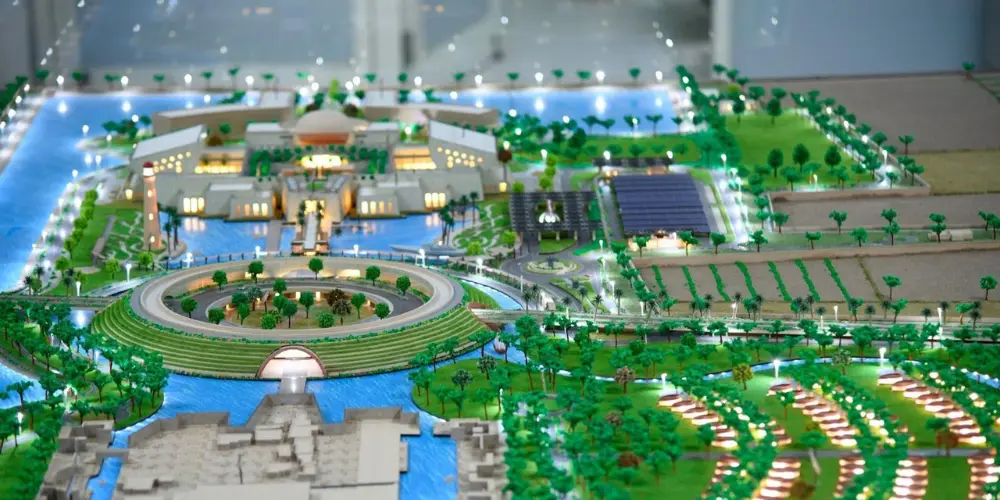
A large gathering space sits at the heart of the town, created so visitors can sit back and enjoy evening shows within Lothal Town itself. With the surrounding water body reflecting light after sunset, the setting shifts from an educational walk to an atmospheric performance venue.
- Dedicated large gathering space for audiences
- Evening shows staged inside the town
- Water body creates a dock-side ambience after dark
- Extends a visit from a few hours into a full day-and-evening experience
This is what pushes NMHC beyond a standard museum stop and towards a destination.
How Lothal Town Fits Into the Wider NMHC Complex
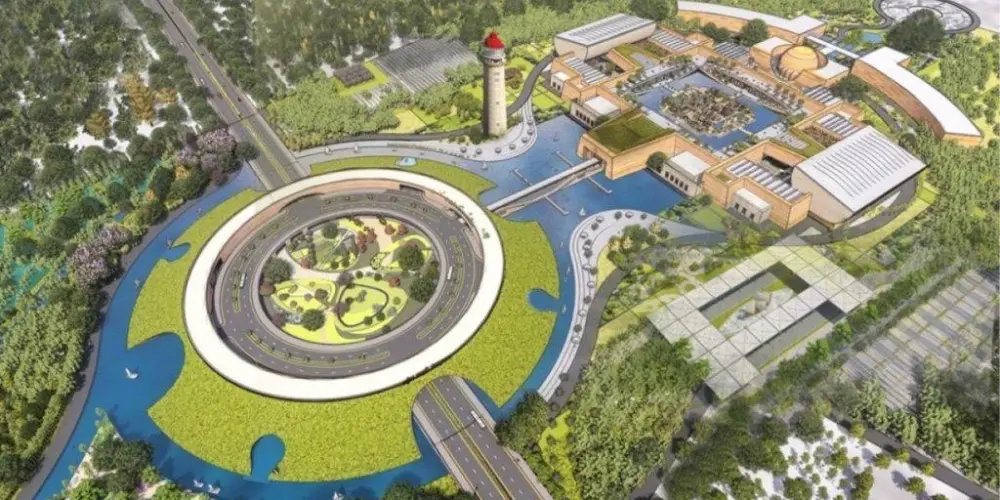
Lothal Town sits inside the National Maritime Heritage Complex at Lothal, Saragwala, Gujarat — a sprawling project telling the story of India’s maritime past across fourteen planned galleries. The town gives that narrative a physical anchor.
- Gallery 1 — Orientation and Oceanic Mythologies, covering ocean science, underwater archaeology and Indian oceanic deities
- Gallery 2 — Harappans: The Pioneer Seafarers, featuring Lothal’s excavated dockyard, Dholavira and trade with Mesopotamia, Oman, Egypt and the Persian Gulf
- Gallery 3 — Post-Harappan trajectories and the impact of climate change
- Gallery 4 — India’s contact with the Greco-Roman world
- Gallery 5 — Special Exhibitions Gallery for rotating shows and collaborations
- Gallery 6 — Evolution of the Indian Navy and Indian Coast Guard
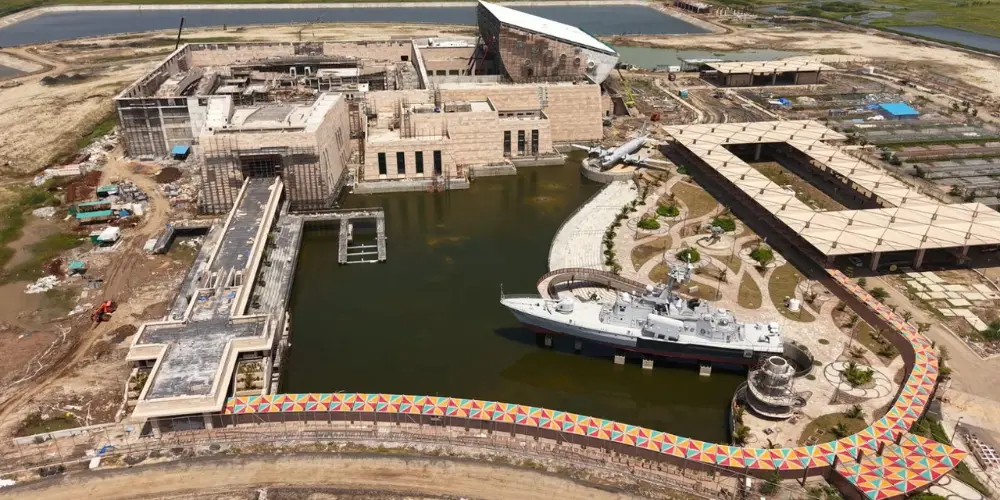
Elsewhere on the campus: the decommissioned INS Nishank, an IL-38SD aircraft, a Sea Harrier, and boating facilities. Future phases include a 5D dome auditorium, a lighthouse museum, coastal state pavilions and themed parks.
Frequently Asked Questions
It’s a re-imagined mini Harappan town inside the central courtyard of the NMHC museum, recreating ancient houses, streets and markets surrounded by a water body inspired by the old Lothal dock.
At the National Maritime Heritage Complex, Lothal, Saragwala, Gujarat 382230 — about 80 km from Ahmedabad.
Walkthroughs of the reconstructed settlement, craft and heritage workshops, food stalls, a barter-based marketplace, and evening shows in the central gathering space.
It recreates how Harappan society traded before money existed, letting visitors experience an economy without any medium of exchange.
Yes. The walkthroughs, workshops and barter market are hands-on and interactive, making it particularly good for school groups and families.