
Introduction
Most cities build first and fix their utilities later. Dholera reversed the order.
Before the first industrial plot changed hands in India’s largest greenfield smart city, a 50 MLD Water Treatment Plant was already running in Gujarat’s Ahmedabad district. Water arrives, gets treated, gets stored, and reaches every category of user through a network designed on paper years before anyone needed it.
The most useful way to understand that system is to follow a single litre through it.
Stage One — Raw Water Becomes Potable
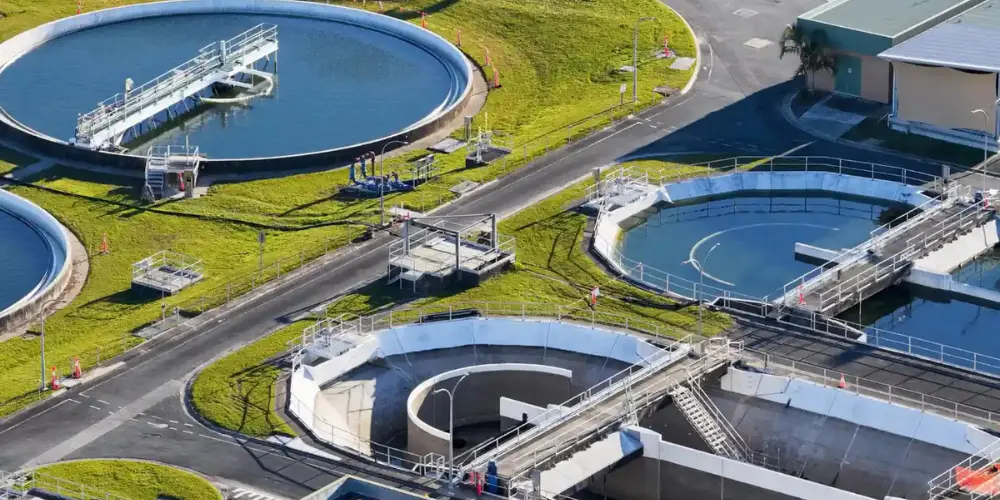
The journey starts at the intake, where raw water is metered before treatment begins. From there it moves through a conventional multi-stage sequence sized for bulk municipal and industrial supply.
- Coagulation and flocculation — dosing binds fine suspended solids into heavier clusters
- Clarification — the large circular tanks visible from the air let those solids settle out
- Filtration — remaining particulate matter is stripped to bring turbidity within potable limits
- Disinfection — a final dose before the water leaves the plant
What emerges meets potable standards and is ready for dispatch at city scale.
Stage Two — Storage That Absorbs the Peaks
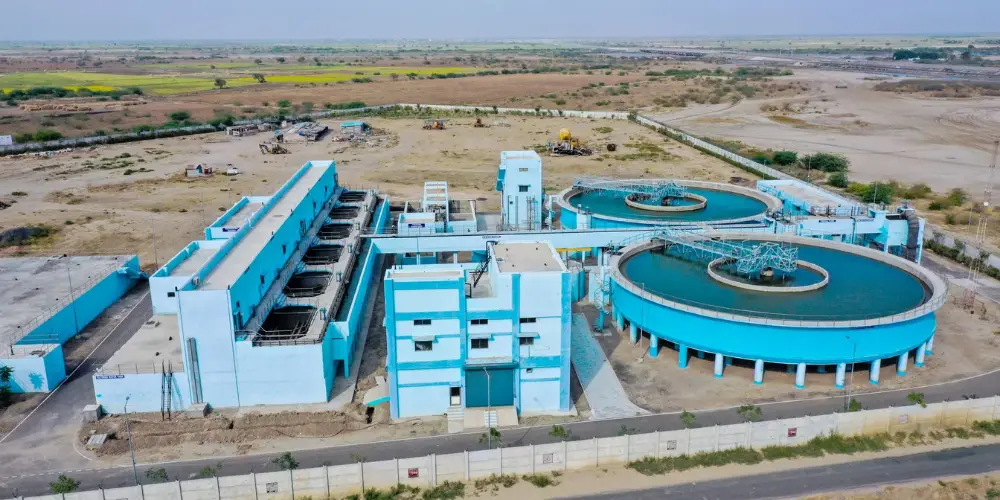
Treated water does not go straight into the pipes. It first enters Mass Balancing Reservoirs (MBRs).
The logic is mechanical rather than glamorous. A treatment plant performs best at steady output; a city consumes in sharp bursts — morning, evening, shift changes. Something has to absorb that mismatch, and the MBR is it. It holds treated volume between production and consumption, lets the plant run flat instead of surging, and keeps an operational reserve available if the intake or a treatment line goes down for maintenance.
It is also the hydraulic starting point for everything downstream.
Stage Three — Gravity Does the Delivery
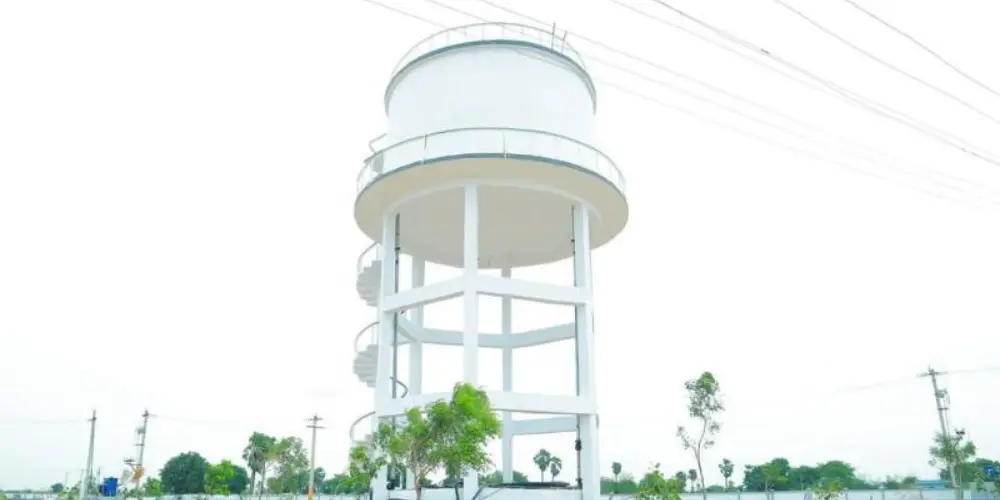
From the MBRs, water moves into a piped supply network anchored by multiple Elevated Service Reservoirs (ESRs) — the tall tanks that create pressure through height rather than pumping.
- Elevation delivers consistent flow with lower energy draw than continuous pumping
- Several ESRs sit across different zones, so no single structure carries the whole load
- Lines run inside dedicated utility corridors, meaning repairs don’t require tearing up working roads
- Zone-wise metering supports leak detection and real demand tracking
That third point quietly solves a problem that defines older Indian cities, where a burst main and a blocked arterial road tend to be the same event.
Who Actually Receives It
The network was planned so reliability doesn’t vary by postcode — a departure from the norm, where water quality and pressure often depend on which side of a city you live on.
| User type | What the network delivers |
| Industrial | Process-grade volume without dependence on on-site treatment |
| Residential | Continuous pressurised supply instead of tanker-supplemented service |
| Commercial | Predictable utility for offices, retail and hospitality operations |
| Institutional | Assured supply for schools, hospitals and public facilities |
The 150 MLD Question
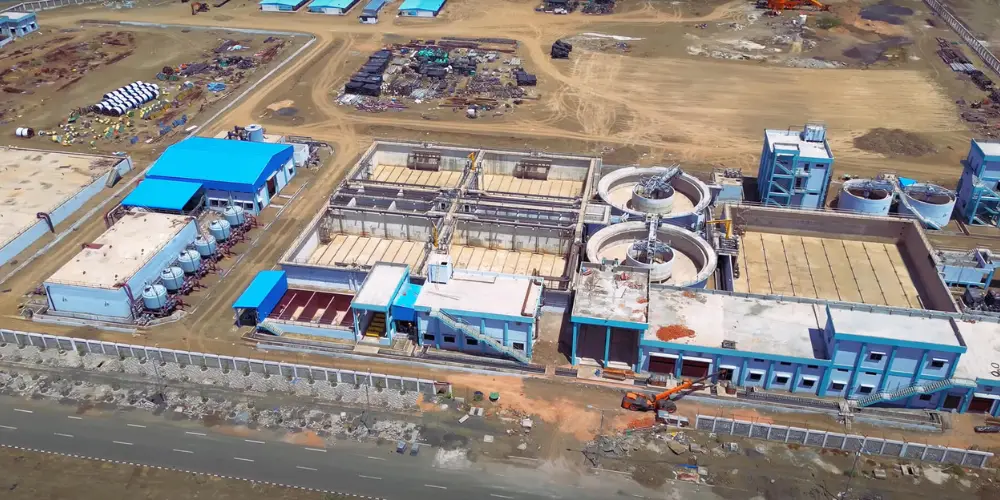
Here is the part of the plant that hasn’t been built yet, and it may be the most important part.
The WTP is designed for augmentation up to 150 MLD — triple its current capacity. Civil layouts, hydraulic design and land have been provisioned for that expansion, so capacity can be added in modules rather than through a disruptive rebuild.
The consequence is strategic. Capacity can track occupancy instead of preceding it by decades, which avoids stranded capital. An anchor tenant negotiating for a large water allocation isn’t bumping against a regional ceiling. And expansion spending stays sequenced with revenue rather than front-loaded onto a city with no users yet.
Headroom, in other words, is the difference between a utility that enables growth and one that eventually caps it.
Why This Changes an Investment Decision
For anyone evaluating land in Dholera SIR, the WTP is less a feature than a signal.
- Lower private capex — fewer borewells, less on-site storage, minimal private treatment
- Faster commissioning — the connection exists before the plot is allotted
- Cleaner compliance — assured supply supports environmental clearance and operational continuity
- Long-term security — a documented path to 150 MLD backs the city’s growth claims
Trunk infrastructure delivered ahead of demand is the clearest available evidence that a greenfield project has moved from masterplan to functioning city.
Frequently Asked Questions
50 MLD, serving the Activation Area of Dholera SIR.
Yes — it is designed for augmentation up to 150 MLD.
Million litres per day, the standard measure of treatment output.
Storage that holds treated water and evens out daily demand swings.
They use gravity to keep pressure consistent across the network.