India’s link with the sea goes back more than 4,500 years. Long before modern ports, the Harappans built one of the world’s oldest known dockyards at Lothal, in Gujarat’s Ahmedabad district.
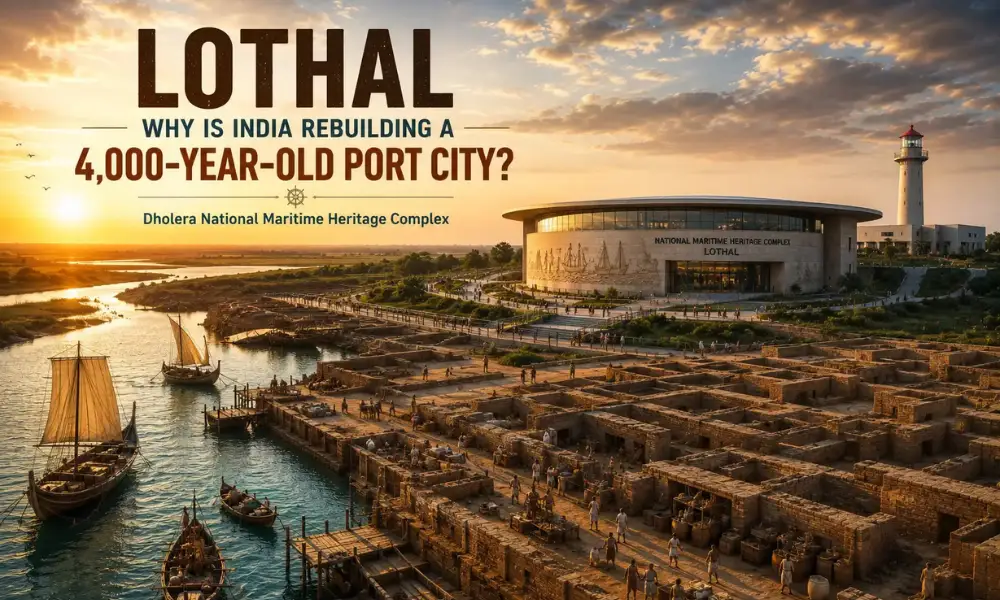
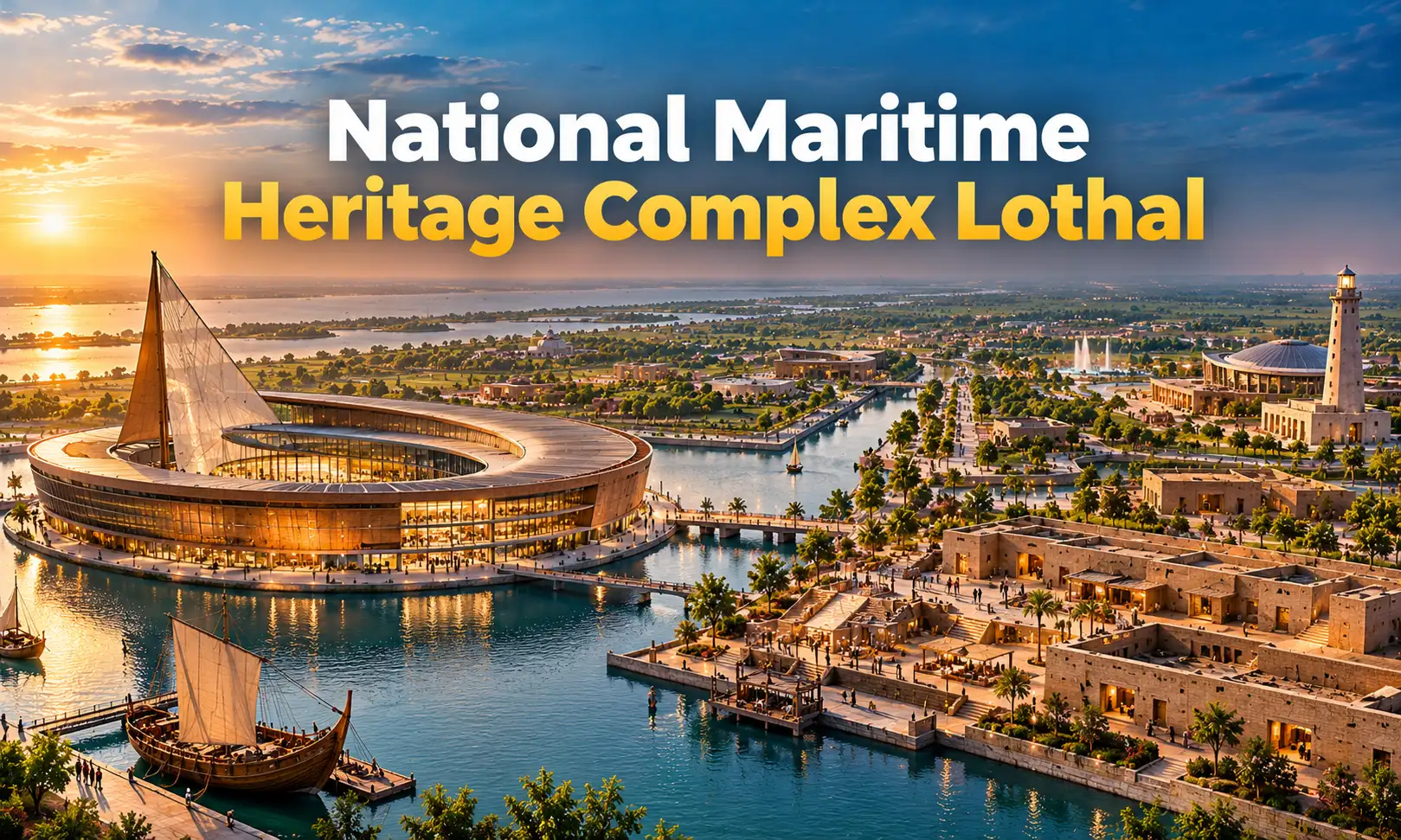
Now that same site is getting a new life. The National Maritime Heritage Complex Lothal (NMHC) is a large heritage and tourism project that will tell India’s maritime story from the Harappan era to the present day.
The master plan shows a lot more than a museum. It includes a recreated ancient city, theme parks, a lighthouse museum, an eco resort, a maritime institute and a nature park, all laid out along a long water channel.
In this guide, we go through the master plan zone by zone, look at where the project stands in 2026, and explain why it matters for the wider Dholera region.
What Is the National Maritime Heritage Complex?
The National Maritime Heritage Complex Lothal is a project of the Ministry of Ports, Shipping and Waterways. It is being built on about 400 acres near the archaeological site of Lothal, roughly 80 km from Ahmedabad.
The project has an estimated cost of around ₹4,500 crore. It is being developed with support from the Gujarat government, the Indian Navy, the Indian Maritime University, major ports and other partner bodies.
The idea is simple. India has a long seafaring history, but there has never been one place where people can see all of it. The National Maritime Heritage Complex Lothal aims to be that place. It mixes a museum with research, learning, leisure and tourism.
Reading the Master Plan: How the Site Is Laid Out
The master plan runs from west to east like a long, narrow ship. The heritage core sits at the western end. As you move east, the plan turns into parks, open water and finally a nature zone.
A central water channel connects many of the zones. This makes the whole complex feel tied to water, which suits its maritime theme.
Here is a quick view of the main zones:
| Zone | What it offers |
| National Maritime Museum | Main galleries on India’s maritime history |
| Lothal Town | Recreation of the ancient Harappan settlement |
| Lighthouse Museum | History of lighthouses on India’s coast |
| Bagicha Complex | Circular garden and public space |
| Lothal City | Larger built zone themed on the ancient city |
| State Pavilions | Maritime heritage of India’s coastal states |
| Four Theme Parks | Maritime & Naval, Monuments, Climate Change, Adventure |
| Eco Resort & Museotels | Stay options inside the complex |
| Maritime Institute & Hostels | Research and training |
| Nature Conservation Park | Green zone at the eastern tip |
| Water Holding Tanks | Water storage and management |
The Heritage Core: Museum, Lothal Town and Lighthouse Museum
National Maritime Museum
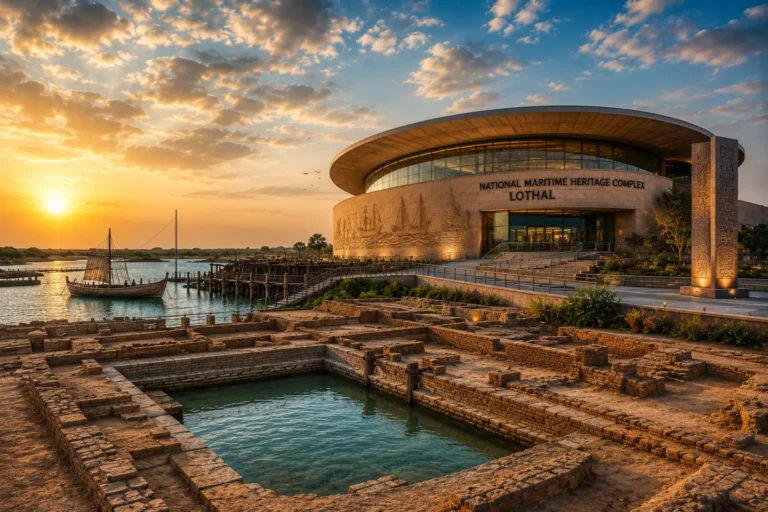
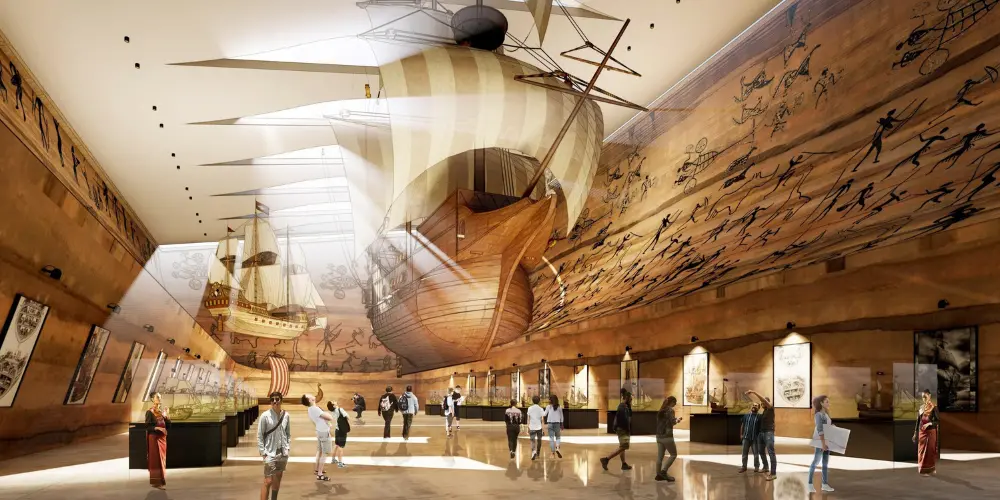
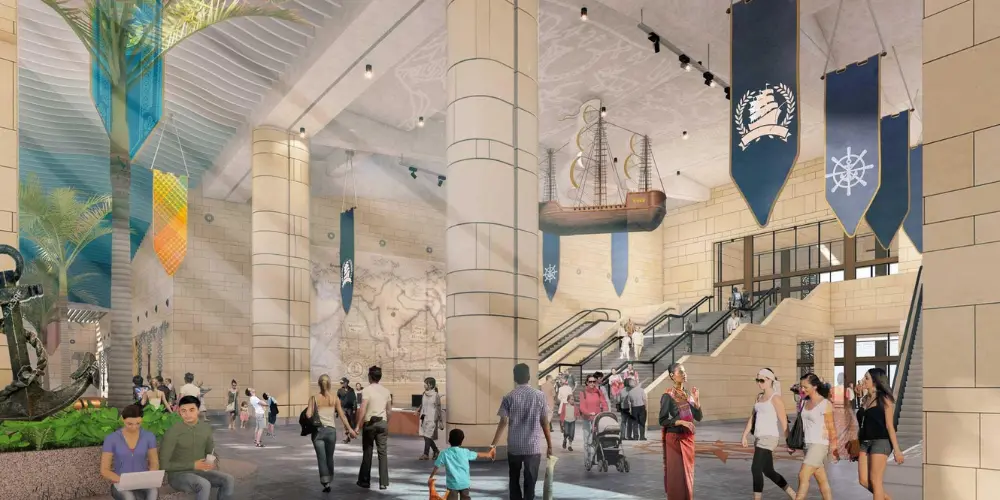
The museum is the heart of the complex. It sits at the western end, set inside a water body. Its galleries will cover India’s maritime timeline, from Harappan trade to the colonial period and the modern Indian Navy.
The museum is planned with many themed galleries. Over 1,400 artefacts are reported to be ready for installation.
Lothal Town
Right next to the museum is Lothal Town. This is a recreation of the Harappan settlement as it may have looked thousands of years ago. Visitors will be able to walk through streets, homes and workshops of an ancient port city.
It turns history from something you read about into something you can walk through.
Lighthouse Museum
Just south of the museum, the Lighthouse Museum will focus on India’s lighthouses. These towers have guided ships along the coast for centuries. The museum will tell their story and show how navigation has changed over time.
Bagicha Complex, Lothal City and State Pavilions
Bagicha Complex
Moving east, you reach the Bagicha Complex. On the master plan, it is a large round garden ringed by water. It works as a green link between the heritage core and the rest of the site.
It is a place to slow down, rest and enjoy open space between the busier zones.
Lothal City
Lothal City is a larger built zone east of the Bagicha. It extends the ancient city theme on a bigger scale. It is expected to hold shops, food spots and cultural spaces with a Harappan-inspired design.
State Pavilions
Each coastal state of India has its own sea story. The State Pavilions will give these states space to show their maritime culture, ports, boats and traditions.
This zone shows that India’s maritime past is not limited to one place. It stretches from Gujarat to Bengal and beyond.
Four Theme Parks Built Around the Sea
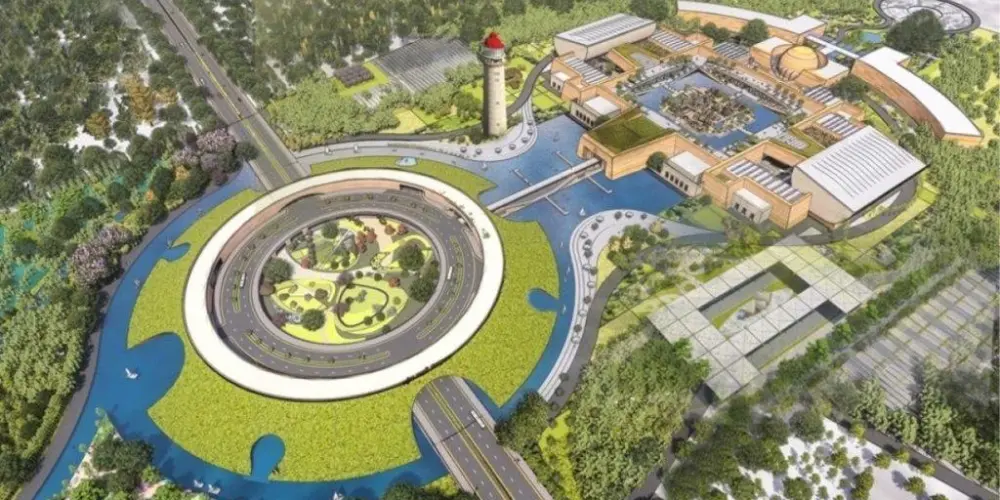
The middle of the master plan holds four theme parks, arranged in a grid of green blocks. Each one has a different focus.
Maritime & Naval Theme Park
This park will be about ships, sailors and naval history. It is expected to include ship models, interactive displays and stories of India’s naval strength over time.
Monuments Theme Park
This park will bring together models and themes from India’s well-known monuments. It gives visitors a cultural break between the more sea-focused zones.
Climate Change Theme Park
Rising sea levels and changing coasts are a real concern for India. This park will explain these issues in a way that is easy for families and students to understand.
Adventure & Amusement Park
This is the fun zone for younger visitors. It is meant to balance learning with rides and activities, so that families can spend a full day at the complex.
Stay, Study and Nature: The Outer Zones
Eco Resort and Museotels
To the north of the channel, the plan shows an Eco Resort laid out in curved rows of cottages. Near it are the Museotels, which are hotels themed around the museum experience.
These stay options mean the complex can be more than a day trip. Visitors can stay overnight and explore at a slower pace.
Maritime Institute and Hostels
At the northwest corner sit the Maritime Institute and its hostels. This zone will support research and training in maritime history, archaeology and related fields.
It gives the project a long-term academic role, not just a tourism role.
Nature Conservation Park
At the eastern tip, the plan opens into a wide nature conservation park beside the water. This area keeps a large part of the site green and natural.
Water Holding Tanks
On the far west, large water holding tanks help manage water for the whole complex. In a coastal area, good water planning is key to keeping the site working well.
Where Does the Project Stand in 2026?
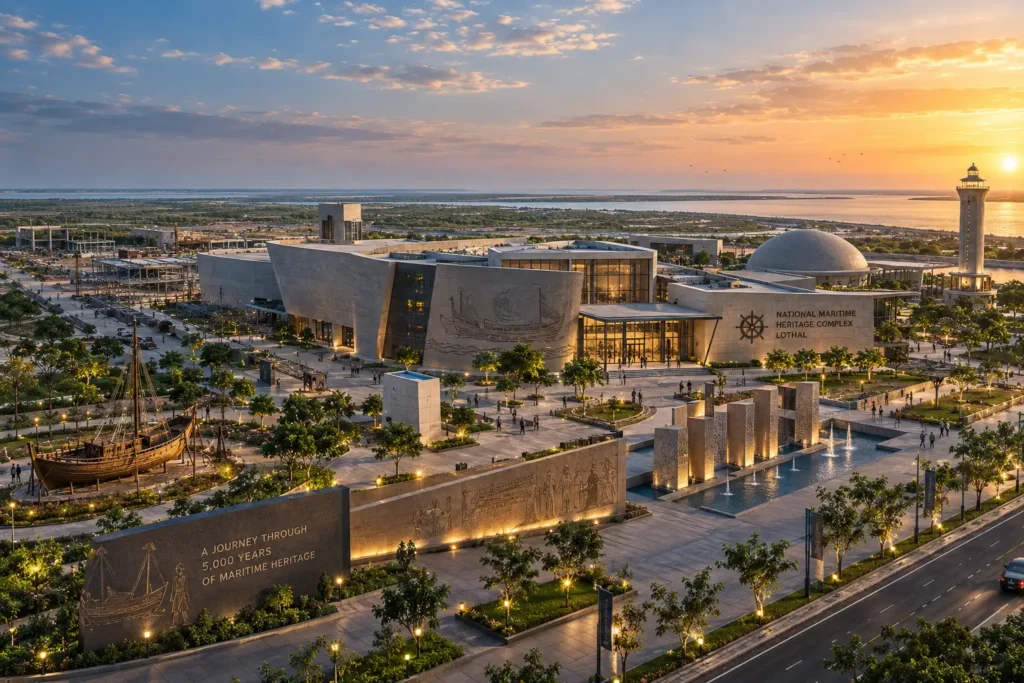
The National Maritime Heritage Complex Lothal is being built in phases:
- Phase 1A covers the main museum galleries, the Lothal Town recreation and water theming. As of September 2026, it was reported to be about 82% physically complete, with a revised target of 31 October 2026.
- Phase 1B and Phase 2 will add more galleries, a 5D dome theatre, a coastal states pavilion, the lighthouse museum, a maritime research institute, museotels and the eco resort.
Other recent updates include:
- Thirteen countries have signed MoUs to partner on the project.
- The National Maritime Heritage Complex Lothal bye-laws have been approved.
- Archaeological excavation work at Lothal by the ASI is well underway.
Timelines for the later phases have not been fixed publicly yet, so dates may shift.
Why the NMHC Matters for Lothal and Dholera
Lothal sits in the Bhal region of Ahmedabad district, a short drive from the Dholera Special Investment Region. Both are part of the same growing corridor south of Ahmedabad.
Large public projects like the National Maritime Heritage Complex Lothal tend to bring roads, visitors and services to an area. Recent updates note that the Ahmedabad–Dholera Expressway is complete and the plan for the high-speed rail link has been finalised.
For the region, this means:
- More tourism: A national-level heritage site brings steady visitor traffic.
- Better connectivity: Expressway and planned rail links make the area easier to reach.
- Local jobs: Hotels, shops, transport and services grow around big attractions.
- Wider attention: National and global focus on Lothal also puts nearby Dholera on more people’s radar.
If you are following the growth of Dholera, the National Maritime Heritage Complex Lothal is one of the projects worth tracking closely. That said, project timelines can change, so it is wise to check official updates before making any plans based on them.
Final Thoughts
The National Maritime Heritage Complex at Lothal is more than a museum. It is a full destination that links history, learning, leisure and nature on one site.
Once complete, it could become one of India’s top heritage attractions. It also adds to the momentum of a region that is already seeing major investment in roads, rail and new cities like Dholera.
For anyone interested in India’s past, or in the future of this corner of Gujarat, the National Maritime Heritage Complex Lothal is a project to keep an eye on.
Short FAQs
It is at Lothal in Ahmedabad district, Gujarat, about 80 km from Ahmedabad.
The Ministry of Ports, Shipping and Waterways leads the project, with support from the Gujarat government, the Indian Navy and other partners.
It spreads over about 400 acres, with an estimated cost of around ₹4,500 crore.
The National Maritime Museum, Lothal Town, Lighthouse Museum, Bagicha Complex, Lothal City, State Pavilions, four theme parks, an Eco Resort, Museotels and a Nature Conservation Park.
Phase 1A was targeted for completion by 31 October 2026. Later phases do not have public dates yet.