Every new city faces the same awkward question in its early years: the factories are coming, but where will the people live, learn, and get treated when they fall ill?
For the Dholera Special Investment Region (SIR), Gujarat’s answer arrived in the state’s annual budget. Finance Minister Kanubhai Desai set aside a series of allocations that shift the region’s focus from pure industrial groundwork toward the everyday amenities that turn an industrial zone into a functioning town — a hospital, a school, a fire station, a desalination plant and more.
It is a smaller headline than a ₹91,000-crore semiconductor fab. It may matter just as much.
What the budget actually allocated
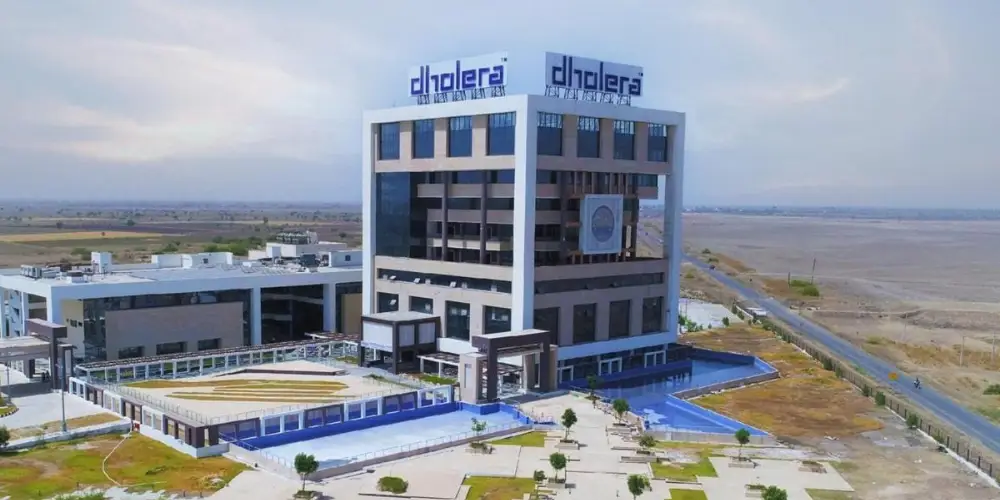
The provisions are specific rather than symbolic, and each one plugs a gap that a greenfield city cannot function without:
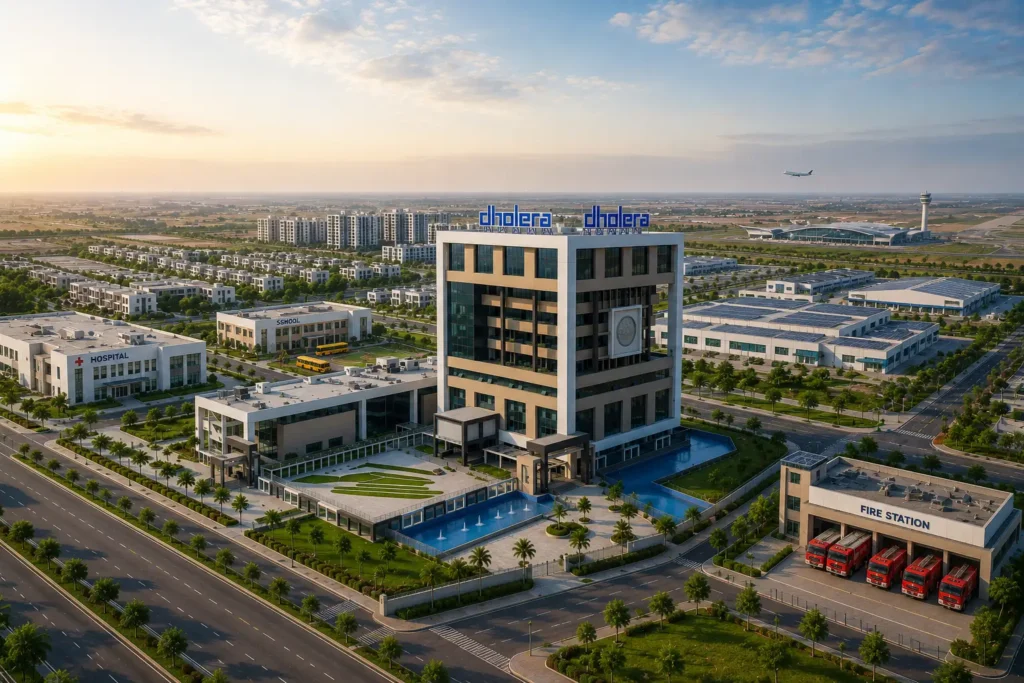
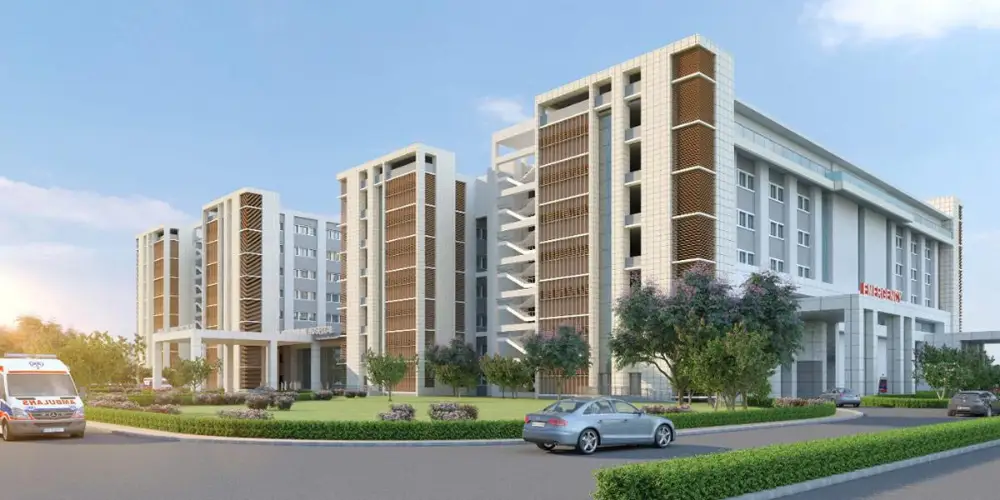
- ₹170 crore for social infrastructure — the hospital and school at Dholera SIR. This is the single largest line item in the package and the clearest signal that residential life is now on the near-term agenda.
- ₹25 crore for a fire station — non-negotiable for a region hosting chemical, electronics and semiconductor manufacturing.
- ₹20 crore for trunk infrastructure augmentation — the backbone utilities of water, drainage, power and roads that everything else plugs into.
- ₹10 crore for sea dredging and land filling at Dholera SPR, to be executed by the Dredging Corporation of India (DCI).
- ₹1 crore for a desalination plant — a first provision toward converting seawater into usable supply.
- ₹1 crore toward an integrated residential township, seeding the planning work for organised housing.
Read together with the wider township and social-infrastructure envelope of roughly ₹200 crore that the state flagged for the region, the intent is clear: build the city, not only the industrial estate.
Why the hospital and school matter more than they look
A semiconductor fab does not run on machines alone. It runs on engineers, technicians, supervisors, contractors and their families — thousands of them, many relocating from Ahmedabad, Bengaluru, Pune or overseas.
Those families ask two questions before they move: where will my child study, and what happens if there is a medical emergency at 2 a.m.?
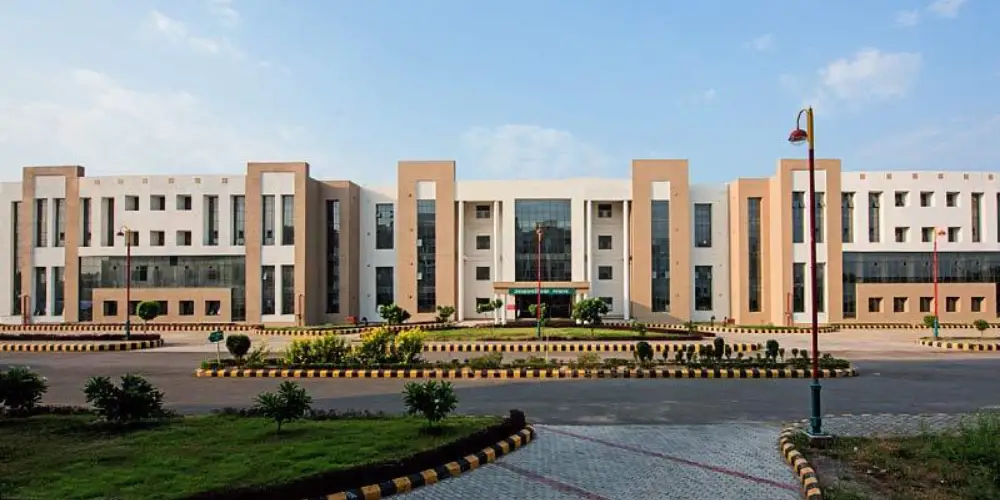
Until now, the honest answer for Dholera was “Ahmedabad, roughly two hours away.” A funded hospital and an integrated school change that calculation. Foundation stones for a fire station, an integrated school and a 200-bed hospital were laid in the region shortly after the budget announcement, moving the plan from paper to site.
For employers, this is a recruitment tool. For the region, it is the difference between a commuter workforce and a resident population — and resident populations are what create demand for shops, clinics, restaurants, gyms and housing.
The fire station: unglamorous, essential
₹25 crore for a fire station rarely makes the front page, but industrial safety compliance is a gating factor for large manufacturers. Insurance underwriting, hazardous-material clearances and factory licensing all depend on emergency response capability within a defined radius.
For a region positioning itself as India’s semiconductor and electronics hub, a dedicated fire station is less an amenity than a prerequisite for the next round of industrial approvals.
Water: the constraint nobody can engineer around
Dholera sits near the Gulf of Khambhat, and coastal Gujarat’s groundwater is largely saline. Meanwhile, semiconductor fabrication is among the most water-intensive industrial processes in existence, requiring vast volumes of ultra-pure water.
The ₹1 crore desalination provision is modest — realistically a planning, survey and preparatory allocation rather than full project funding. But it establishes desalination as part of the region’s official water strategy alongside the Narmada canal network. For a coastal industrial city with this kind of industrial mix, diversifying water sources is not optional; it is the long-term survival plan.
Dredging and trunk infrastructure: building the ground itself
The ₹10 crore dredging allocation is easy to overlook. What it funds is literal land creation — dredged material used for filling and level-raising in low-lying coastal terrain that would otherwise be difficult to build on. Handing execution to the Dredging Corporation of India brings specialist capability to a technically demanding job.
The ₹20 crore trunk infrastructure augmentation, meanwhile, extends the underground utility corridors, water lines, drainage and power networks that Dholera’s activation area has been building out. Every new plot, factory and housing block ultimately connects to this spine.
How this fits the bigger Dholera picture
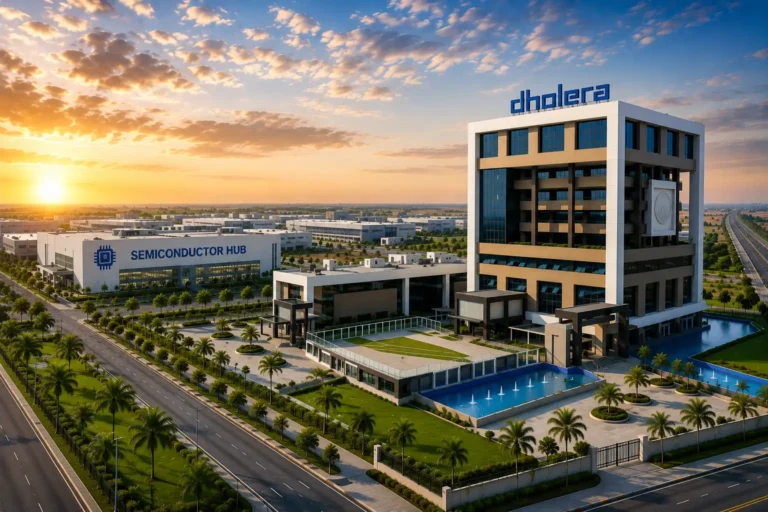
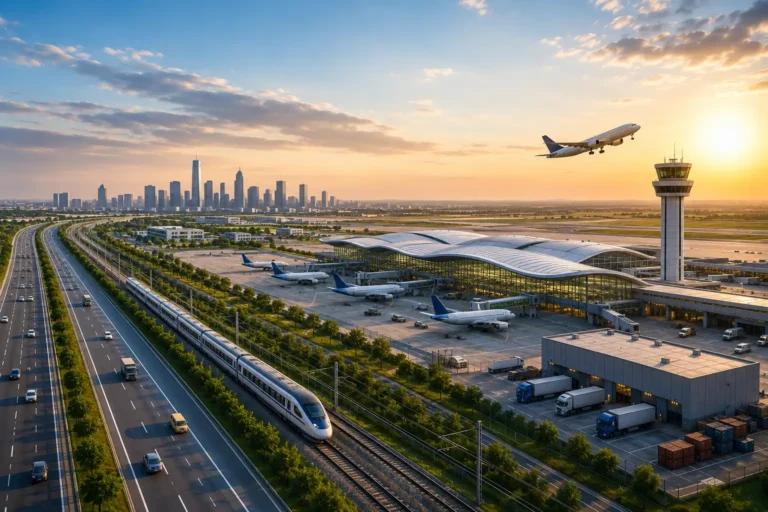
These allocations land alongside the region’s marquee projects: the Tata Electronics–PSMC fab, the Ahmedabad–Dholera Expressway that has cut travel time dramatically, and the Dholera International Airport now well advanced. Industrial anchors, connectivity and civic amenities are, for the first time, progressing on parallel tracks rather than in sequence.
That parallelism is what separates a working city from an industrial park with a long commute.
What it means if you are watching Dholera
For investors: social infrastructure is the classic precursor to end-user demand. Land near planned schools, hospitals and townships tends to behave differently from purely speculative parcels. That said, verify every plot’s L-Form, zone certificate and title before committing — activity in the region has attracted its share of unregistered operators.
For businesses: amenity availability is now a genuine talking point in workforce planning, not a promise.
For future residents: the timelines are multi-year. Budget allocation is a starting gun, not a finish line, and execution pace is the number worth tracking.
Frequently asked questions
The Dholera Special Investment Region is India’s first greenfield smart industrial city, spread across roughly 920 sq km in Gujarat’s Ahmedabad district, developed along the Delhi–Mumbai Industrial Corridor.
₹170 crore for social infrastructure covering both the hospital and school at Dholera SIR.
A 200-bed hospital was among the projects for which foundation stones were laid, along with an integrated school and fire station.
The region is coastal with saline groundwater, and its industries — semiconductors in particular — are highly water-intensive. Desalination diversifies supply.
The Dredging Corporation of India (DCI), under a ₹10 crore allocation for land filling at Dholera SPR.