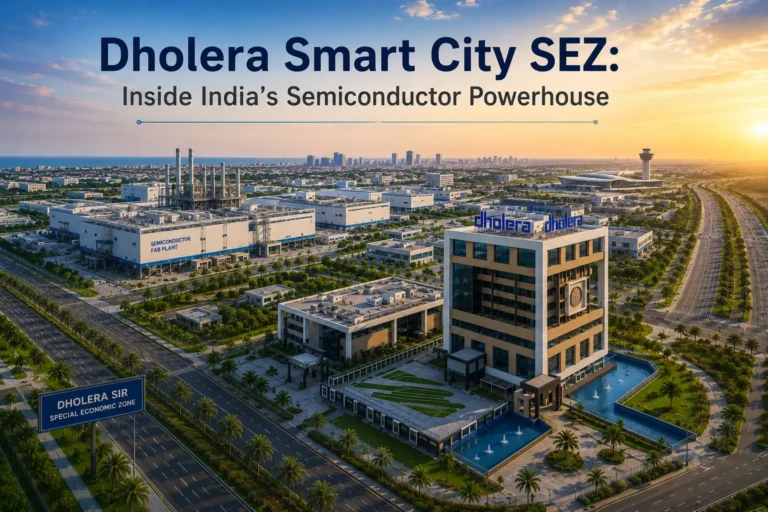
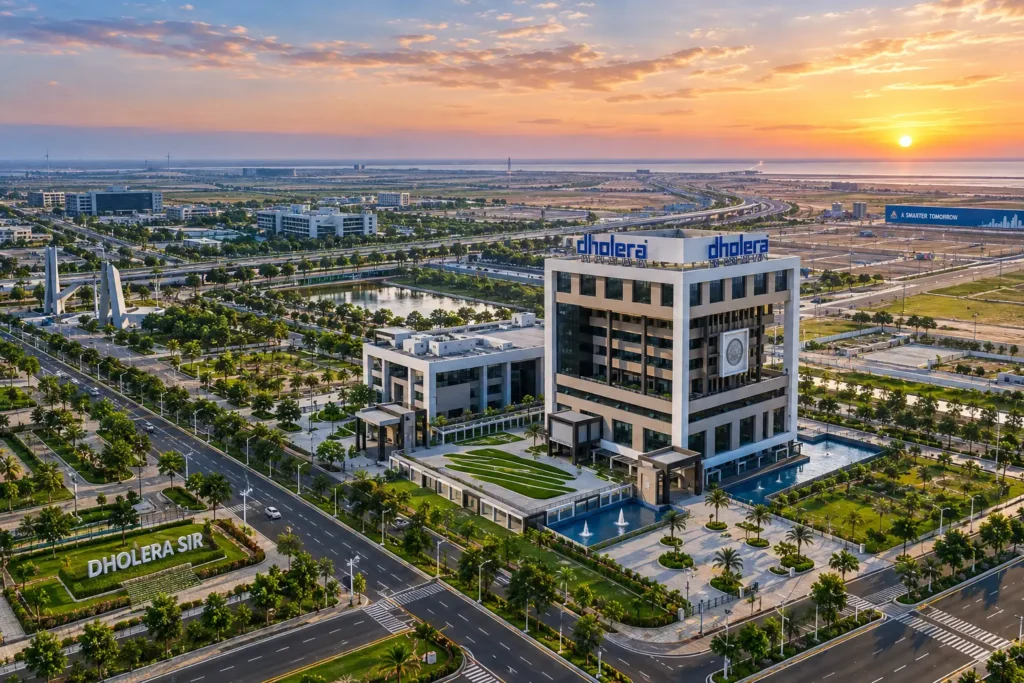
Most Indian cities grew first and were planned later. Roads were widened around buildings that already existed, drainage was retrofitted into neighbourhoods that had outgrown it, and power lines were strung above streets that never anticipated them. Dholera reverses that order.
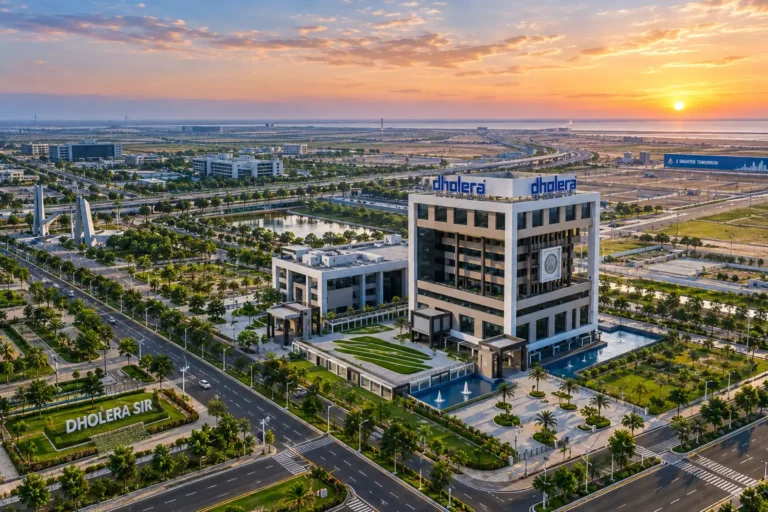
Spread across roughly 920 sq km on the Gulf of Khambhat in Gujarat’s Ahmedabad district, Dholera Smart City is India’s first greenfield smart city and the largest node of the Delhi–Mumbai Industrial Corridor. Land was pooled, town planning schemes were sanctioned, and trunk infrastructure went into the ground before the first factory arrived. That sequence is the reason a set of advantages exists here that established industrial belts simply cannot replicate.
Here are the twelve differentiators that define the project, grouped into the themes that matter most to an industrialist or investor evaluating it.
1. World-Class Infrastructure, Built Before You Arrive
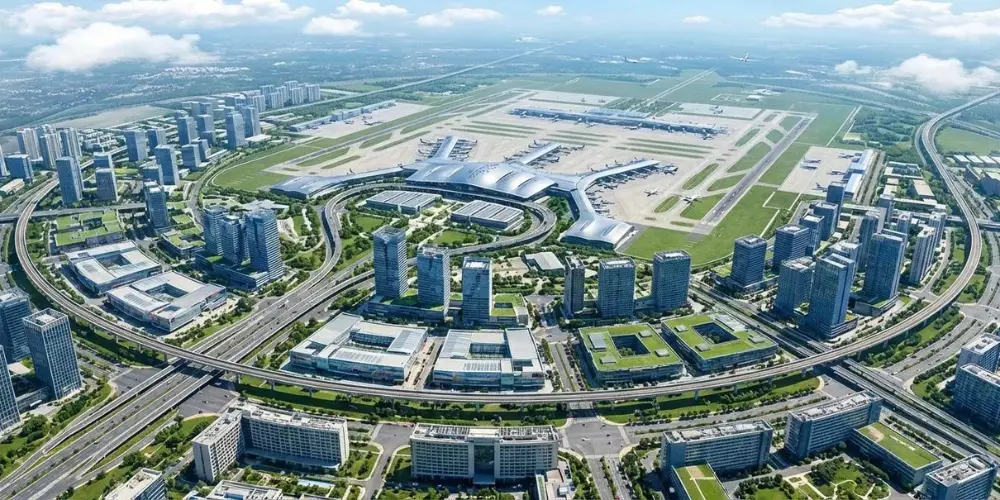
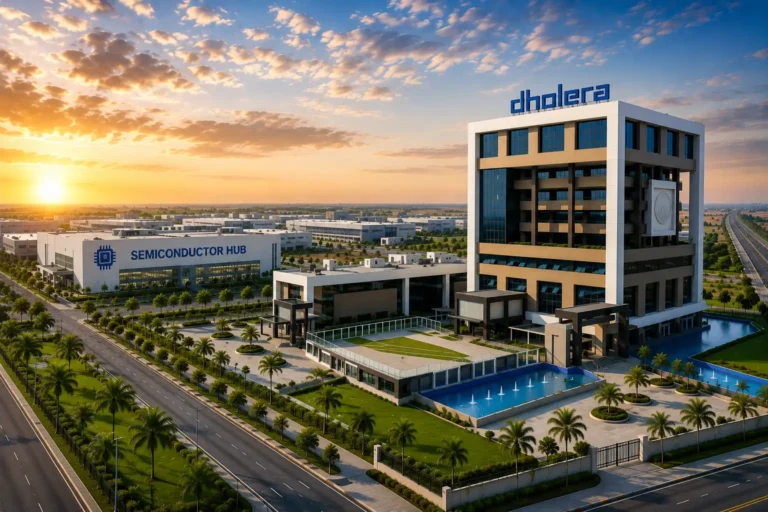
In Dholera, water supply, sewerage, storm-water drains, recycled water lines, power cables, gas and ICT ducts all run through a common underground utility corridor beneath the road network. Nothing is overhead, and nothing needs to be dug up later. Phase 1, covering Town Planning Schemes 1 and 2, already has this backbone in place along with the ABCD (Administrative and Business Centre for Dholera) building acting as the city’s command centre. For a manufacturer, this means the plot boundary is where your responsibility begins — not where a two-year fight for a power connection starts.
2. Plug & Play Plots That Compress Your Timeline
The phrase “plug and play” gets used loosely in Indian industrial marketing. In Dholera it has a specific meaning: allotted plots arrive with metered water, treated water, power, sewerage and fibre already terminated at the boundary. Add pre-sanctioned land use and a demarcated zone, and a project that would take three to four years to reach the ground elsewhere can begin construction almost immediately. This is precisely why capital-intensive projects have gravitated here — the Tata Electronics–PSMC semiconductor fab, designed for 50,000 wafers a month at the 28nm node with an investment of around ₹91,000 crore, is the most visible example.
3. Ease of Governance and Fast-Track Approvals
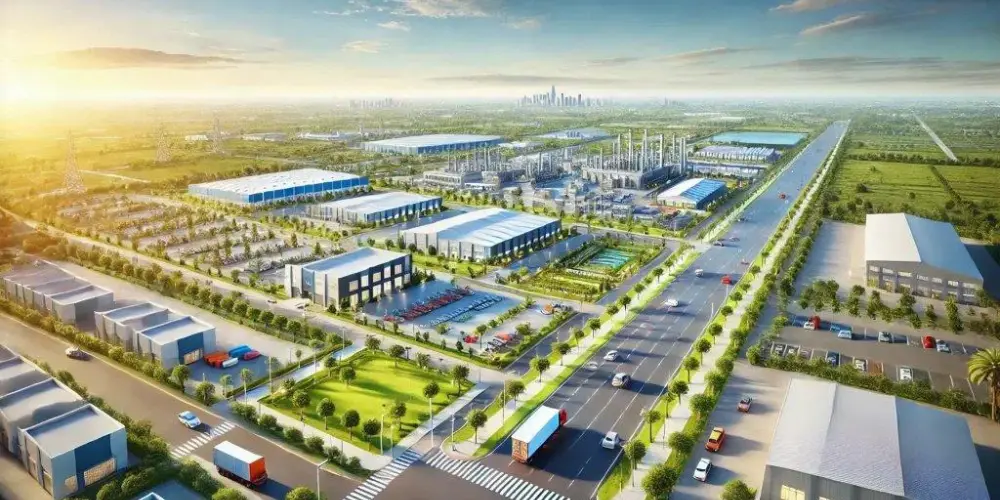
Dholera operates under its own dedicated legal and administrative framework through the Gujarat Special Investment Region Act, with DSIRDA as the single planning and permitting authority. That removes the usual scramble across a municipal corporation, a development authority, a pollution board and a district collectorate. A single-window clearance system handles building permissions, and approvals that routinely consume months in older industrial estates are compressed into weeks. Fewer counters means fewer discretionary points — which is as much a governance advantage as a speed one.
4. Ease of Business Across the Full Investment Lifecycle
Beyond approvals, the region offers a transparent land allotment process, defined lease and freehold structures, and an investment facilitation setup that stays engaged after the deal closes. Gujarat’s policy environment layers on top of this — semiconductor incentives, data centre policy, renewable energy provisions and MSME support all apply here. The result is that Dholera competes not just on land price but on total cost and predictability of setting up.
5. Connectivity, External and Internal

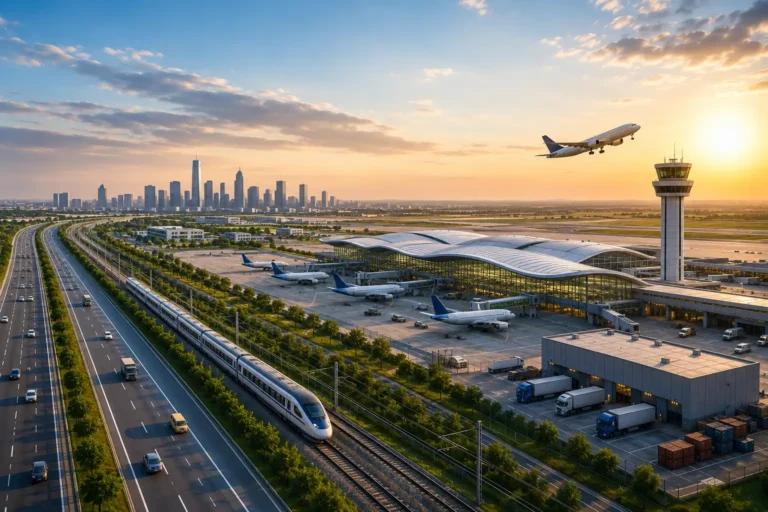
Externally, Dholera sits at the intersection of several major projects: the six-lane Ahmedabad–Dholera Expressway cutting travel time to roughly an hour, the under-construction Dholera International Airport near Navagam, a sanctioned semi-high-speed rail corridor to Ahmedabad, and proximity to Gujarat’s western ports for export logistics.
Internally, the city is built around a central spine road with a hierarchical grid of arterial and sub-arterial roads, dedicated freight routes, and provision for metro and BRTS along reserved right-of-way. Freight never has to cross residential zones — a separation that most retrofitted Indian cities gave up on decades ago.
6. Social Infrastructure and a Genuine Live-Work-Play City
An industrial region that requires its workforce to commute from 100 km away is a half-built project. Dholera’s master plan allocates land for schools, hospitals, retail, recreation, sports facilities and mixed-income housing within the same town planning schemes as the industrial zones. Knowledge and recreation zones, a riverfront along the Sabarmati channel, and planned green belts are part of the layout rather than an afterthought. For companies recruiting skilled engineers, this is the difference between attracting talent and merely bussing in labour.
7. Technology, Security and Sustainability by Design
Dholera runs on an ICT layer — smart metering, intelligent traffic management, city-wide surveillance, and a central command and control centre that monitors utilities in real time. The same digital spine supports the security grid being built out for the semiconductor cluster.
On sustainability, the city is designed with a large share of land under green cover and water bodies, a 4,400 MW ultra-mega solar park nearby, mandatory treated-water reuse, and storm-water systems designed for the region’s flat coastal terrain. Because the plot was blank, the environmental engineering could be done properly the first time.
What This Means for You
The twelve advantages are not independent selling points — they compound. Fast approvals matter more when the utilities are already live. Plug-and-play plots matter more when an expressway and airport connect them to markets. Social infrastructure matters more when a semiconductor fab needs 20,000 skilled workers who will actually want to live there.
Dholera is still a phased project, and timelines on individual assets have moved before. Anyone investing should verify the specific TP zone, its sanction status and its utility rollout schedule against official DSIRDA documentation rather than a brochure. But the underlying proposition is unusually clear: this is what an Indian city looks like when the planning comes first.
Frequently Asked Questions
In Ahmedabad district, Gujarat, roughly 100 km southwest of Ahmedabad along the Gulf of Khambhat.
The Special Investment Region spans about 920 sq km, developed in phases through 2040. Phase 1 (TP1 and TP2) is the most advanced.
Water, recycled water, power, sewerage, gas and ICT connections terminated at the plot boundary, with pre-approved land use and single-window building permissions.
Semiconductors lead — including the Tata Electronics–PSMC fab — alongside electronics, renewable energy, data centres, defence and aerospace, and heavy engineering.